Reactions
The YAML has three groups of reactions: two param-stage reactions that
assemble bisGMA from BPA + 2×HIE at runtime, four cure-stage reactions
that polymerize STY and HIE radicals, and two cap-stage reactions that
restore vinyl double bonds on any monomer that did not react.
Building bisGMA at runtime
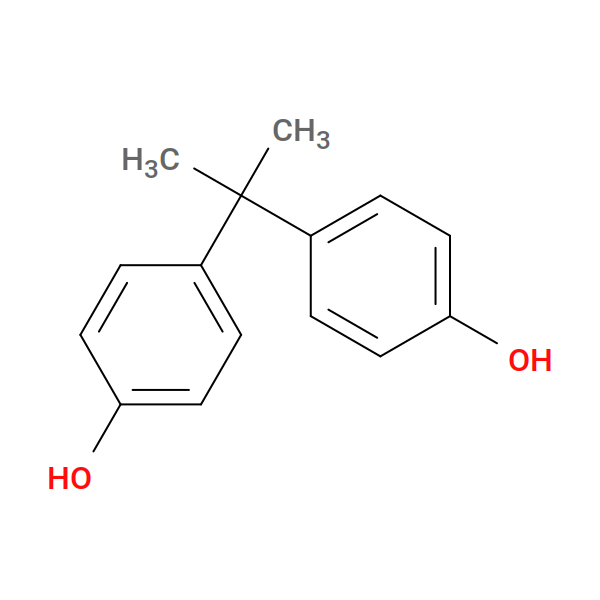
Fig. 11 Bisphenol-A (BPA)¶ |
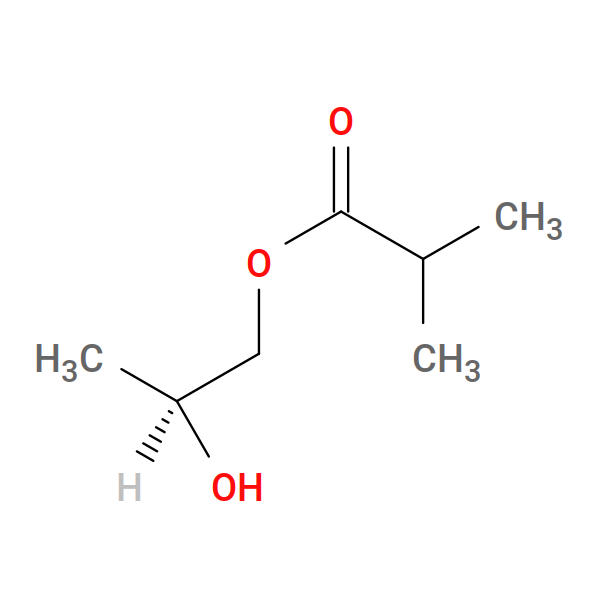
Fig. 12 2-hydroxypropyl isopropyl ester (HIE)¶ |
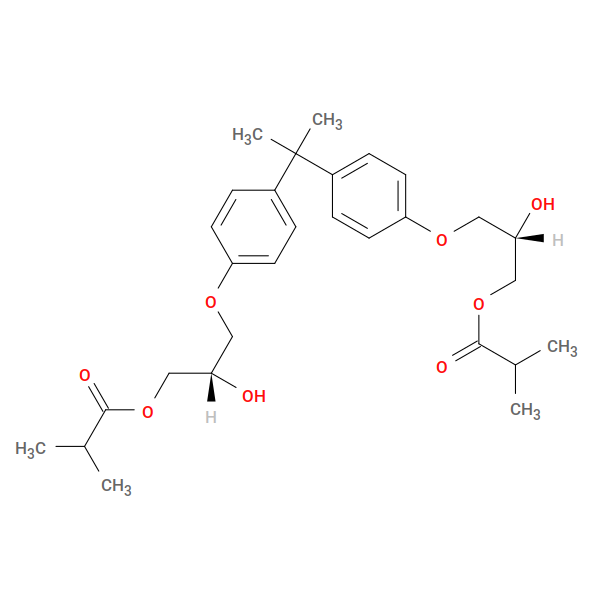
Fig. 13 bisGMA (active form)¶ |
The first reaction esterifies one HIE onto one of BPA’s two phenolic hydroxyls:
- name: B1
  stage: param
  reactants:
    1: BPA
    2: HIE
  product: GM1
  atoms:
    A:
      reactant: 1
      resid: 1
      atom: O1
      z: 1
    B:
      reactant: 2
      resid: 1
      atom: C4
      z: 2
  bonds:
    - atoms: [A, B]
      order: 1
The intermediate GM1 then reacts with a second HIE on the other phenolic
hydroxyl:
- name: B2
  stage: param
  reactants:
    1: GM1
    2: HIE
  product: GMA
  atoms:
    A:
      reactant: 1
      resid: 1
      atom: O2
      z: 1
    B:
      reactant: 2
      resid: 1
      atom: C4
      z: 1
  bonds:
    - atoms: [A, B]
      order: 1
Both reactions are stage: param because the product needs to be
GAFF-parameterized. Once both run, the system has a fully parameterized
GMA template ready to be inserted into the initial liquid.
Why build GMA at runtime rather than supply a pre-made GMA.mol2? The
reason is that the two HIE moieties in a GMA each house a reactive C=C
double bond, and we want htpolynet to treat them as equivalent HIE
sites during cure. By keeping HIE as the canonical reactive species in
the cure reactions, the chain-expanded template set is much smaller
than it would be if GMA itself appeared on either side of a cure bond.
Cure reactions
Cure proceeds by C=C double-bond opening: C1 of one radical bonds to
C2 of another, with each side donating a sacrificial H. On both STY
and HIE, C1 is the radical carbon and C2 is the terminal methyl.
We need to cover all four reactant combinations:
Attacker (C1 owner) |
Attackee (C2 owner) |
|---|---|
HIE |
HIE |
STY |
STY |
STY |
HIE |
HIE |
STY |
Each row gets a single C1-attacks-C2 cure reaction in the YAML
(four reactions total; see 2-bisgma-styrene-thermoset.yaml for the
full block — they all have the same structure as the polystyrene example,
just with the appropriate reactant pair).
Cap reactions
Any STY or HIE monomer that didn’t react during CURE still carries its
saturated “active” form. The cap reactions convert the leftover C1–C2
single bonds back to the natural double bond:
- name:         styCC
  stage:        cap
  reactants:    {1: STY}
  product:      STYCC
  probability:  1.0
  atoms:
    A: {reactant: 1, resid: 1, atom: C1, z: 1}
    B: {reactant: 1, resid: 1, atom: C2, z: 1}
  bonds:
    - atoms: [A, B]
      order: 2
- name:         hieCC
  stage:        cap
  reactants:    {1: HIE}
  product:      HIECC
  probability:  1.0
  atoms:
    A: {reactant: 1, resid: 1, atom: C1, z: 1}
    B: {reactant: 1, resid: 1, atom: C2, z: 1}
  bonds:
    - atoms: [A, B]
      order: 2
Chain expansion
htpolynet automatically generates the trimer and tetramer templates
needed to cover the dihedral environments that arise as polymer chains
grow. Because the four cure reactions span 2 monomer types × 2 attacker
roles, there are 8 distinct trimer sequences, with the templated bond
in one of two positions in each sequence → 16 trimer templates. For
tetramers, only the middle (second–third) bond position is needed (the
other positions are already covered by the trimer templates), giving
16 tetramer templates. Total chain-expanded cure templates: 32.
You do not list these explicitly; htpolynet reports the expanded set
in the diagnostic log at the start of a run.
The next page walks through the full configuration file.