Reactions
In a diepoxide + diamine system, the two crosslinking reactions are:
Primary → secondary amine. A primary amine on PACM (
-NH₂) reacts with one carbon of an opened oxirane on DGEBA. One N–H and one C–H are sacrificed; a new C–N bond forms.Secondary → tertiary amine. The secondary amine from reaction (1) can react again with another DGEBA carbon, forming a tertiary amine.
For PACM and DGEBA these are:
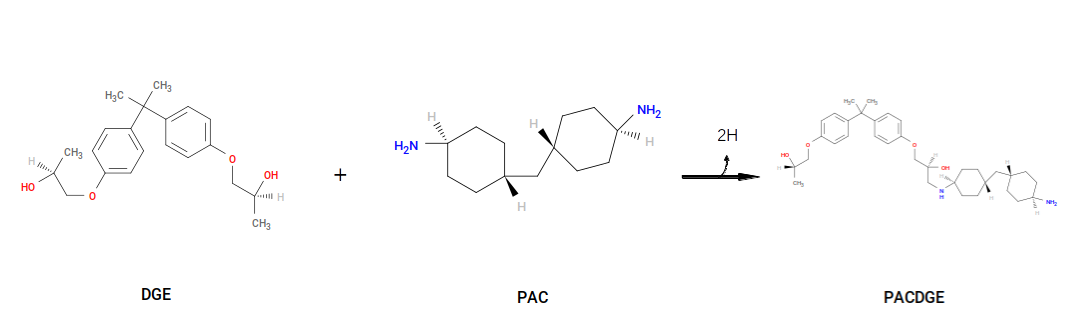
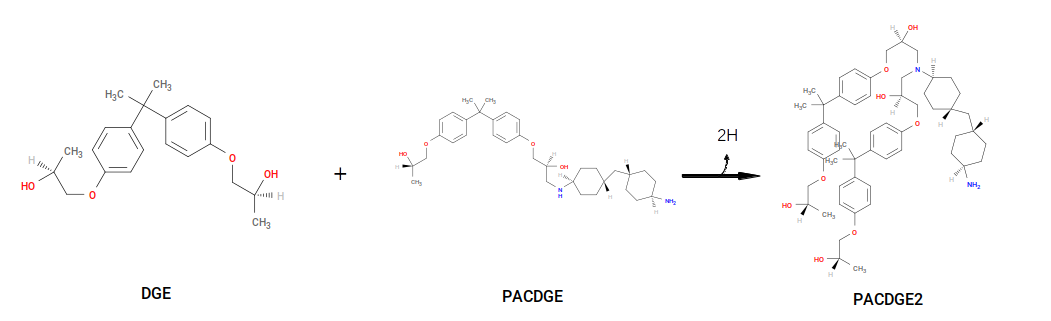
The first reaction’s product, called PAC~N1-C1~DGE, is itself a
reactant in the second; this is what gives the cure step-growth
character. Both products serve as parameterization templates:
PAC~N1-C1~DGE provides the local environment around a new secondary
amine, and PAC~N1-C1~DGE-C1~DGE provides the environment around a
new tertiary amine. When a CURE bond forms, the atom types, charges,
and bonded interactions in the affected region of the system get mapped
from these templates onto the growing network.
The YAML directive for the primary-to-secondary reaction:
- name:        'Primary-to-secondary-amine'
  stage:       cure
  reactants:
    1: PAC
    2: DGE
  product:     PAC~N1-C1~DGE
  probability: 1.0
  atoms:
    A: {reactant: 1, resid: 1, atom: N1, z: 2}
    B: {reactant: 2, resid: 1, atom: C1, z: 1}
  bonds:
    - atoms: [A, B]
      order: 1
A few things to call out about the syntax:
stage: curesays this reaction happens during the iterative CURE loop (not capping).probability: 1.0means any candidate bond that survives all other filters will always form.atoms.A.z: 2saysN1must have two available crosslink sites for this reaction to fire — i.e. it must still be a primary amine. After it bonds once, its remainingzdrops to 1 and only the next reaction (below) is eligible.atoms.B.z: 1saysC1has only one available crosslink site (it has only one sacrificial methyl H), which is consistent with forming a single C–N bond per carbon.
The secondary-to-tertiary directive:
- name:        'Secondary-to-tertiary-amine'
  reactants:
    1: PAC~N1-C1~DGE
    2: DGE
  product:     PAC~N1-C1~DGE-C1~DGE
  stage:       cure
  probability: 0.5
  atoms:
    A: {reactant: 1, resid: 1, atom: N1, z: 1}
    B: {reactant: 2, resid: 1, atom: C1, z: 1}
  bonds:
    - atoms: [A, B]
      order: 1
Notes:
Reactant 1 is now the product of the first reaction (
PAC~N1-C1~DGE) rather than free PAC; the N1 of that residue is now a secondary amine withz: 1.probability: 0.5encodes the empirical fact that secondary-to-tertiary amine formation is intrinsically slower than primary-to-secondary. Each candidate bond passes a uniform random draw against this probability before forming.
Capping
After CURE converges, any DGEBA carbon that still has a sacrificial H left needs to revert to its closed-epoxide form. The cap reaction:
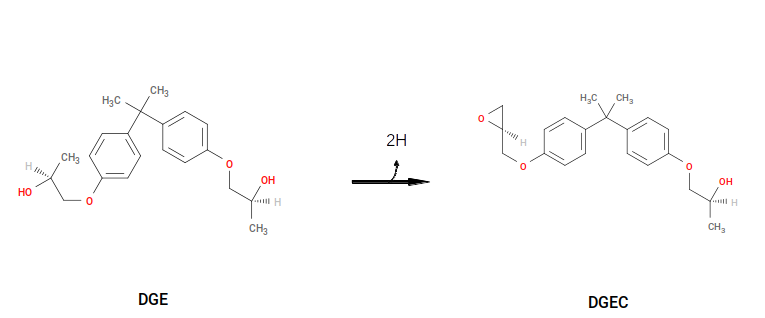
- name:        'Oxirane-formation'
  reactants:
    1: DGE
  product:     DGEC
  stage:       cap
  probability: 1.0
  atoms:
    A: {reactant: 1, resid: 1, atom: O1, z: 1}
    B: {reactant: 1, resid: 1, atom: C1, z: 1}
  bonds:
    - atoms: [A, B]
      order: 1
This is an intra-monomer bond: A and B are both on residue 1 of
reactant 1. It closes the three-membered C–O–C ring by forming a new
C–O bond between the hydroxyl oxygen and the still-unreacted carbon,
removing the two leftover sacrificial Hs in the process.
With these three directives in place, htpolynet knows everything it
needs about the chemistry. The next page covers how
symmetry_equivalent_atoms and stereocenters interact with these
reactions to produce the full set of templates the runtime actually
uses: The Configuration File.