Monomers
DGEBA
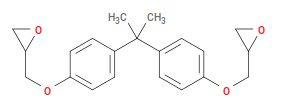
Bisphenol A diglycidyl ether — we keep
the historical abbreviation DGEBA (residue name DGE) — is
bisphenol A with each phenolic oxygen extended into a glycidyl
(epoxide) group. The natural SMILES for DGEBA is:
CC(C)(C1=CC=C(C=C1)OCC2CO2)C3=CC=C(C=C3)OCC4CO4
But htpolynet needs the active form: every reactive atom carries
a sacrificial hydrogen that is deleted when a new bond forms. For
epoxy-amine chemistry, the amine donates its H to the oxirane oxygen and
the epoxide C–O bond breaks to form the new C–N bond. So the epoxide
ring has to be pre-opened in our input structure into a methyl +
hydroxyl pair: CC(O) replaces each oxirane ring.
In SMILES that becomes:
CC(C)(c1ccc(OC[CH:3]([OH:5])[CH3:1])cc1)c1ccc(OC[CH:4]([OH:6])[CH3:2])cc1
with atom-mapping tokens picking out the four reactive atoms. This is
exactly what the YAML’s constituents.DGE block contains:
DGE:
  smiles: "CC(C)(c1ccc(OC[CH:3]([OH:5])[CH3:1])cc1)c1ccc(OC[CH:4]([OH:6])[CH3:2])cc1"
  reactive_atoms: {1: C1, 2: C2, 3: C3, 4: C4, 5: O1, 6: O2}
  count: 200
  symmetry_equivalent_atoms: [[C1, C2], [C3, C4], [O1, O2]]
  stereocenters: [C3]
Six atoms get explicit names:
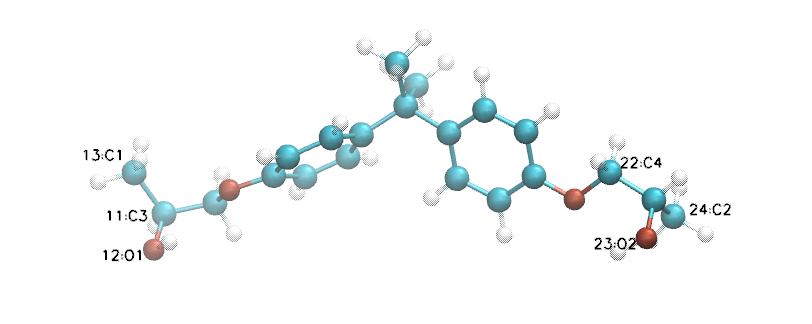
C1, C2 — the two reactive carbons (the sacrificial methyls). These are the atoms an amine nitrogen will bond to.
C3, C4 — the two stereocenters (the carbons bearing the hydroxyl). Opening the oxirane creates a chiral centre; we declare
C3andhtpolynetproduces the appropriate diastereomer pool viasymmetry_equivalent_atoms.O1, O2 — the two hydroxyl oxygens. They get explicit names because the cap reaction re-forms an epoxide three-ring (
O–Cbond) on any unreacted carbon.
PACM
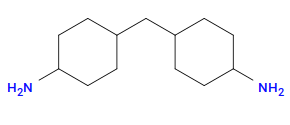
PACM
(4,4-diaminodicyclohexylmethane, residue name PAC) has two primary
amines, one on each cyclohexyl ring. Because each amine has two N–H
bonds, each can react twice (with two different epoxides), so a single
PACM can crosslink up to four DGEBAs. Native SMILES:
C1CC(CCC1CC2CCC(CC2)N)N
The atom-mapped form (matching the YAML’s constituents.PAC block):
PAC:
  smiles: "C1C[CH:1](CCC1CC2CC[CH:2](CC2)[NH2:3])[NH2:4]"
  reactive_atoms: {1: C1, 2: C1, 3: N1, 4: N1}
  count: 100
  symmetry_equivalent_atoms: [[N1, N2], [C1, C2]]
  stereocenters: [C1]
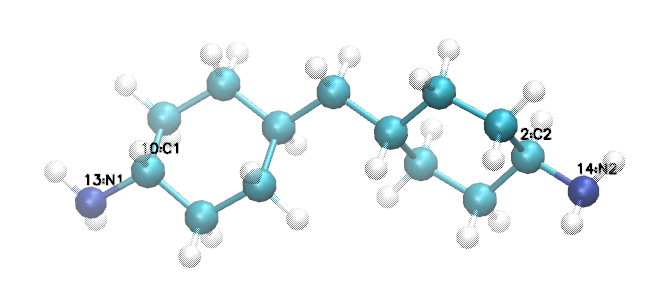
Both amine carbons are named C1 and both nitrogens are named N1
in reactive_atoms — the symmetry_equivalent_atoms block is what
tells htpolynet to internally relabel the second copies as C2 /
N2 so the reactions block can refer to them unambiguously.
The next page describes the reaction dictionaries that drive the cure.